
A public university strike over salaries began on 2nd October 2026 in Kenya. One public statement published is: “On October 12, 2026, the unions officially rejected a Ksh 12 billion counter-offer from the government, calling it insufficient to cover economic realities.” However, rather than striking, university professors/scholars should offer intellectual solutions to grow Kenya's Gross Domestic Product (GDP) and address their salary needs through these solutions.
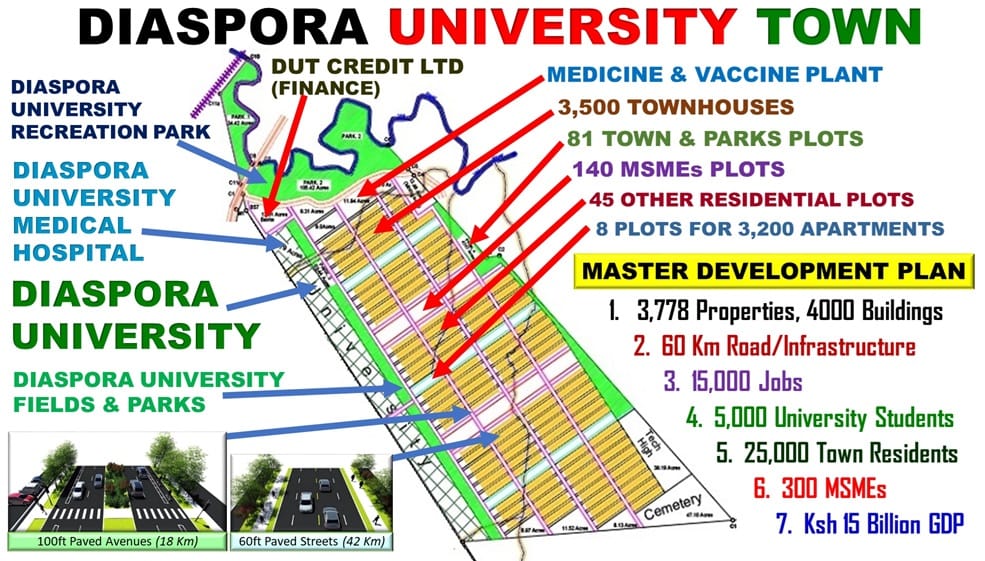
To fund the over Ksh 12 billion pay increase that professors and scholars consider economically viable, the government faces two main options: increasing public taxes or raising student fees by expanding student loans. Neither option is ideal without elaborate economic sustainable plans that ensure that the constitutional rights of the Kenyans paying the taxes and the students paying the fees are advanced.
The professors of the universities can achieve their pay increase through focusing on the universities primary roles of advancing research and transferring knowledge. When performing these roles, the Professors should challenge themselves to be the drives of Kenya GDP and Per capita growth.
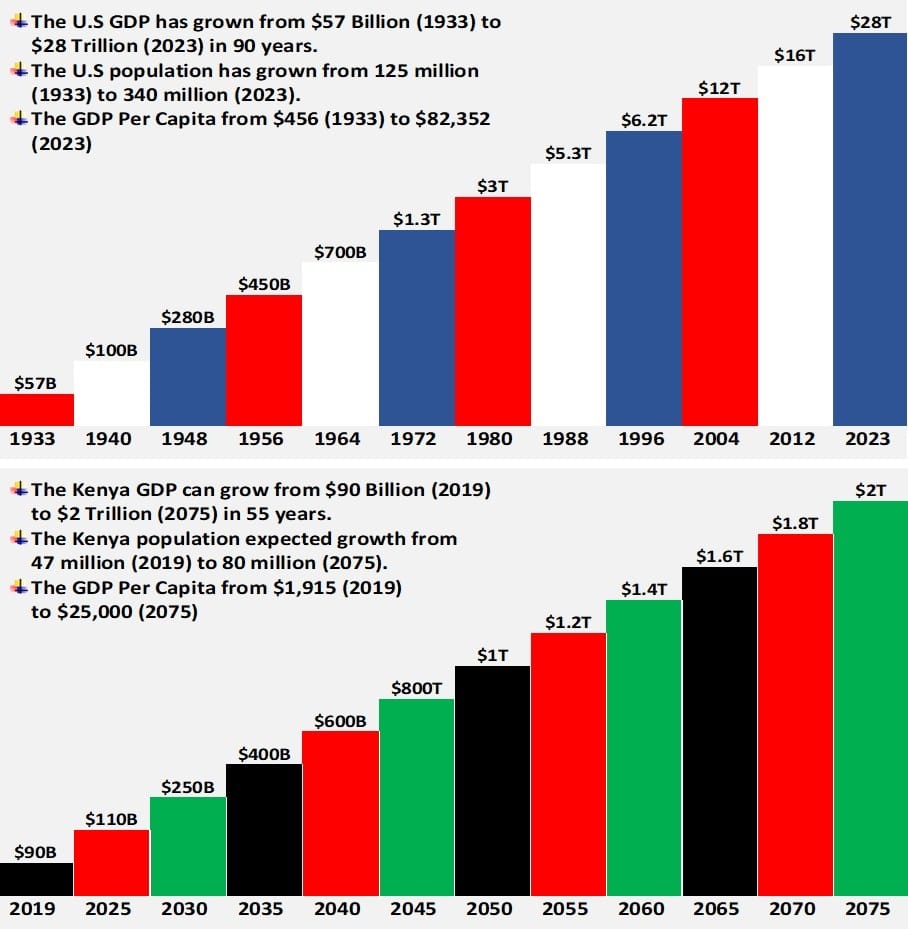
Kenya has a land area of 580,000 sq km, a population of 54 million, a GDP of $150 billion (Ksh 19 trillion), and a per capita income of $2,700. In contrast, South Korea has 100,000 sq km, a population of 52 million, a GDP of $2.2 trillion, and a per capita income of $43,000. This comparison highlights the potential for university professors and scholars to help grow Kenya's economy from $150 billion to $2 trillion and, in turn, sustainably increase their own compensation as Kenya's per capita grows past the $40,000 already achieved by South Korea.
Article 230 of the Constitution of Kenya establishes the Salaries and Remuneration Commission (SRC). The role and principles of public pay are in 203 (4) and (5) as follows: “(4) The powers and functions of the Salaries and Remuneration Commission shall be to— (a) set and regularly review the remuneration and benefits of all State officers; and (b) advise the national and county governments on the remuneration and benefits of all other public officers. (5) In performing its functions, the Commission shall take the following principles into account— (a) the need to ensure that the total public compensation bill is fiscally sustainable; (b) the need to ensure that the public services are able to attract and retain the skills required to execute their functions; (c) the need to recognise productivity and performance; and (d) transparency and fairness.
Reports state that we have 1 million public service jobs currently accounting for a Ksh 1.2 trillion wage bill. University professors, scholars and student's should invite the SRC commissioners to the universities for intellectual debates on pay. SRC can thereafter apply the intellectual solutions achieved to advise the national and county governments on the remuneration and benefits of public officers.
The debates should take into account the constitutional requirement: "the need to ensure that the total public compensation bill is fiscally sustainable." This intellectual debates should find the solutions to increase the pay for the professors and scholars.
(Dan Kamau the writer is the Diaspora University Town www.dut.or.ke Project Director and can be reached through Email dan@dut.or.ke or WhatsApp +254 743 203 168)
JOINING DUT ILLUSTRATION
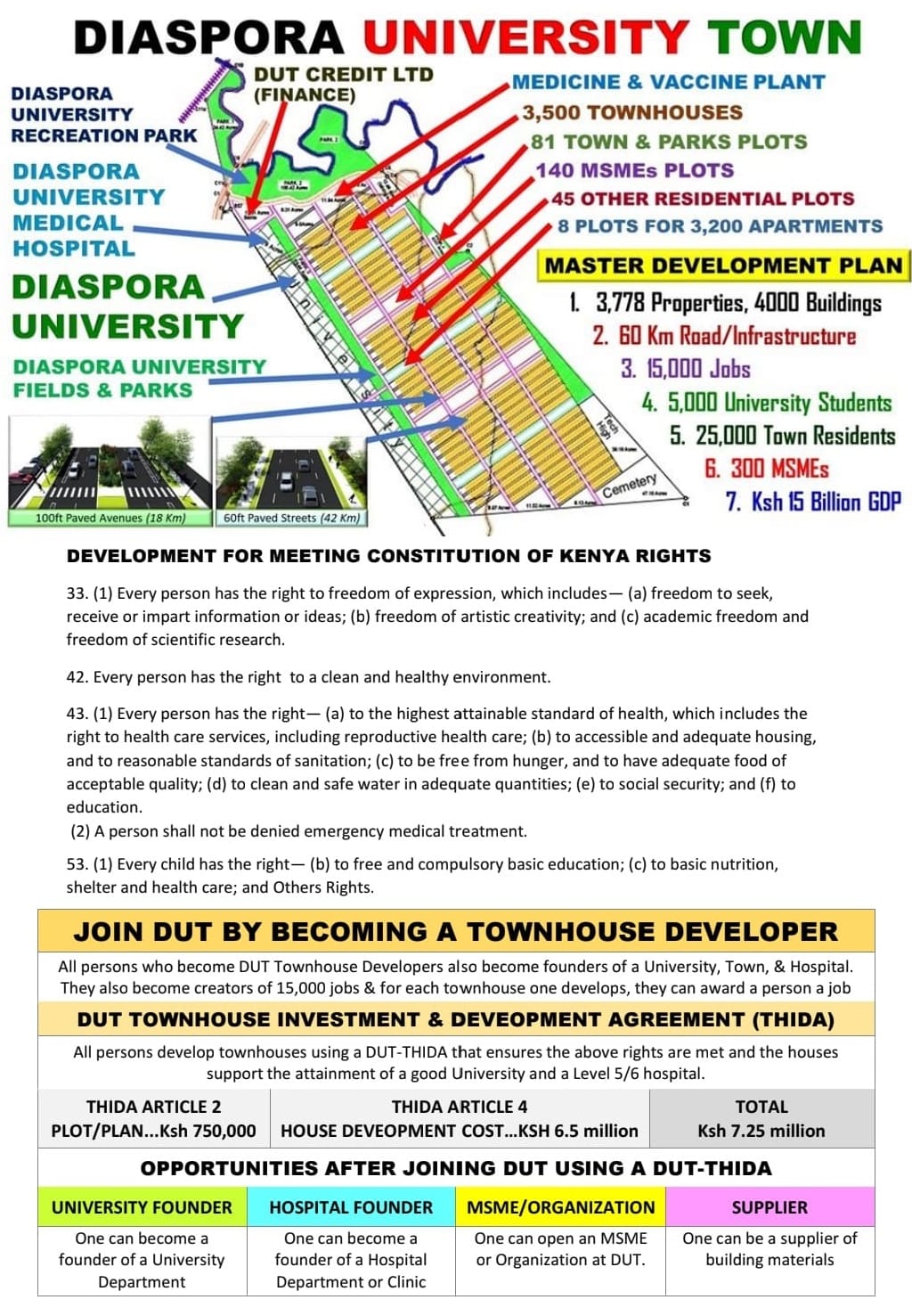
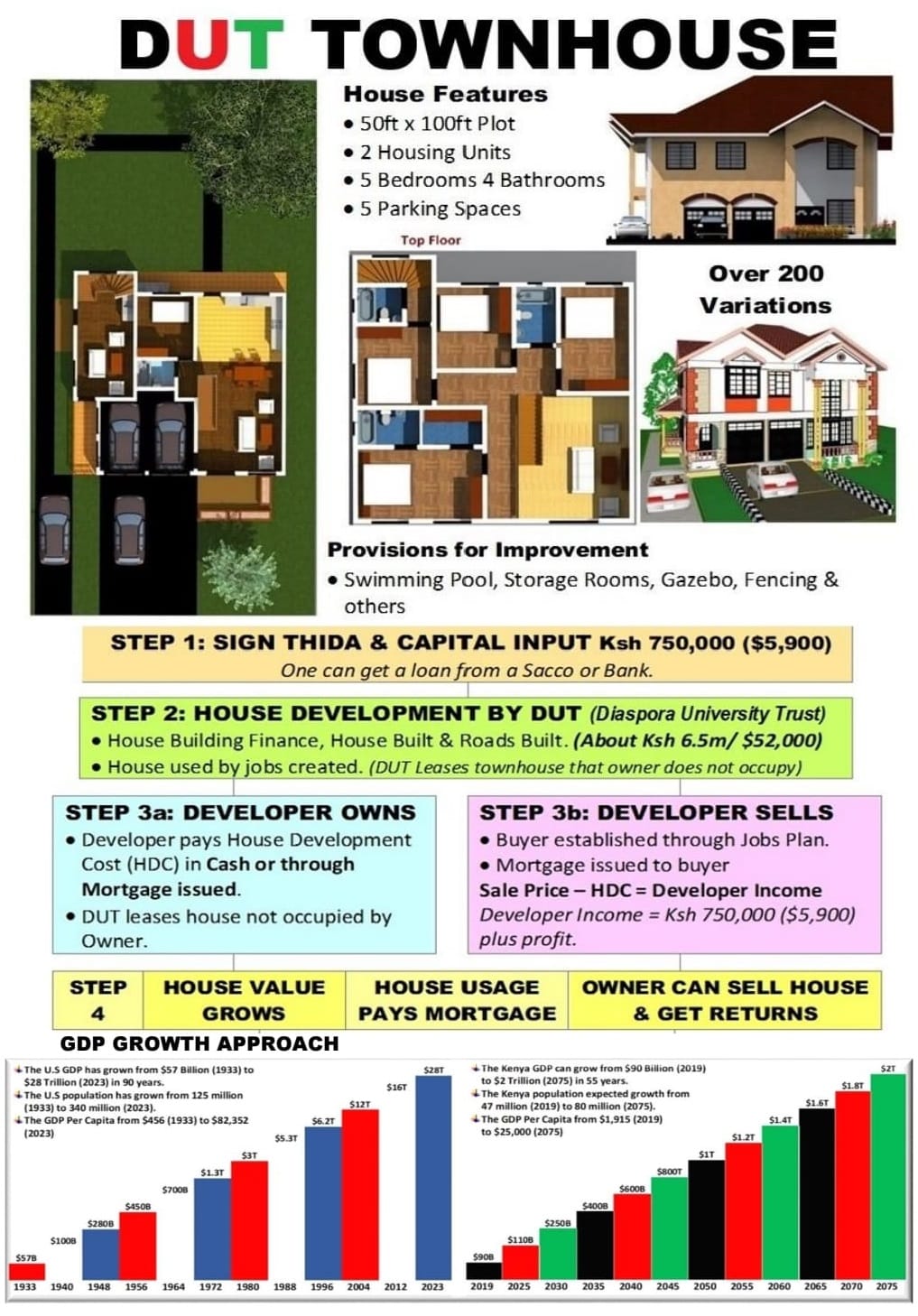
A Teacher/Government Employee or Kenyan can use the DUT system and available banking products to develop a DUT Townhouse. This illustration shows how a Government employee can apply Ksh 11,632 a month of their pay to earn Ksh 1 million by becoming a DUT townhouse developer.
CLICK HERE TO DOWNLOAD DUT THIDA
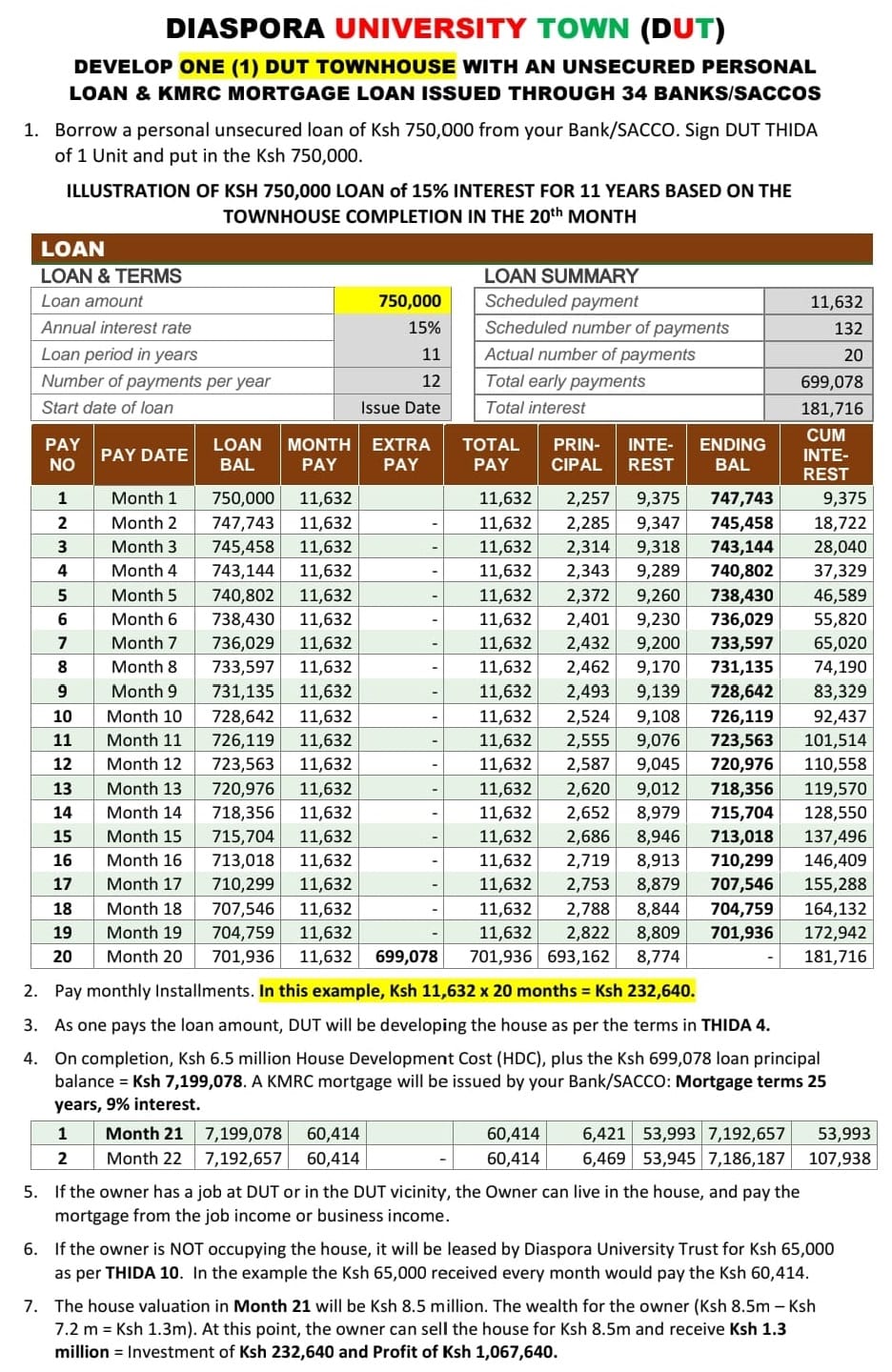

For every Kenyan family to achieve good housing over 20 million formal jobs need to be created and 7 million housing units developed in the next 10 years (by 2035), as Kenya's population grows to 65 million. The DUT system and its developers will create as many jobs as possible and develop as many houses as possible. For example a developer who sells a DUT townhouse unit and achieves Ksh 1.3 million will have the opportunity to build more housing units and grow their wealth using the DUT job creation and housing development system.
FREQUENT ASKED QUESTIONS (FAQ) & ANSWERS
CONTACTS
Dan Kamau +254 743 203 168
Ronald Mwangombe +254 704 494 185
Lucy Malemba +254 723 898 827
Naomi Masawi +254 759 952 559